
Learning to sail is an exciting and rewarding adventure, and the best way to start is with a recognised course from the Royal Yachting Association (RYA). We offer a full range of RYA courses on the safe, inland waters of Farmoor Reservoir, providing a clear path from your first time in a boat to developing advanced skills.
Our structured courses are designed to build your confidence step-by-step. Whether you are an adult looking for a new hobby or booking for a child aged eight or older, our focus is on making your journey safe, supportive, and enjoyable.
Our RYA Sailing Courses
The best way to learn to sail is by finding a course that fits your age and what you want to achieve. At Oxford Sail Training Trust, we offer the full range of Royal Yachting Association (RYA) courses. These are designed to build your skills progressively, ensuring you feel comfortable and capable on the water from your very first session.
Our training pathways are split into schemes for adults and for junior sailors. This means the teaching style, pace, and even the boats we use are perfectly suited to the person learning. The journey is straightforward: you start by exploring your options, learn the practical skills, and then work towards your qualifications.
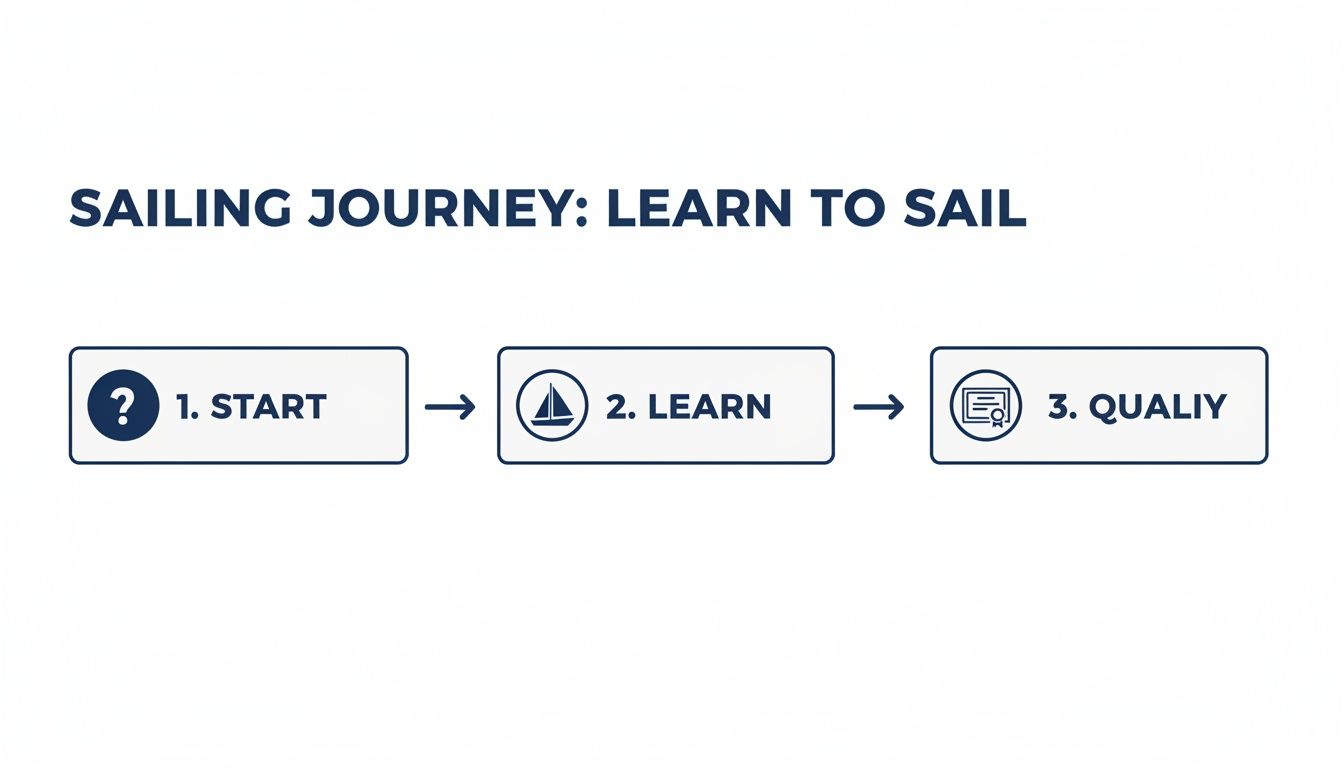
As you can see, getting into sailing is a clear, three-stage process, not a complicated leap into the unknown.
Courses for Junior Sailors (Aged 8+)
For our younger enthusiasts, the RYA Youth Sailing Scheme is a fantastic, fun, and safe introduction to the sport. The scheme is broken down into four clear stages, with each one building on the skills learned in the last.
- Stage 1: This is where it all begins. Children learn how to launch a dinghy, steer, and handle the boat, with the main goal of building water confidence.
- Stage 2: Young sailors develop core skills, learning how to tack (turning the boat through the wind) and control their speed.
- Stage 3: By this point, children become independent sailors. They will be able to launch and sail a dinghy in any direction in moderate conditions.
- Stage 4: This final stage polishes their abilities. It introduces them to sailing a double-handed boat as both crew and helm, preparing them to solve problems afloat.
Our multi-activity weeks during school holidays are also incredibly popular. They offer a brilliant way for children to try sailing alongside other watersports.
Courses for Adults
For adults new to sailing, the RYA National Sailing Scheme provides a clear progression from complete novice to confident, independent sailor.
The adult courses are all about practical skills and good decision-making. We want to give you the competence to handle a boat on your own and make safe choices on the water.
The scheme is built around three main levels.
- Level 1 Start Sailing: This two-day course is your complete introduction. You will cover everything needed to get afloat under supervision, including rigging the boat, launching, and basic sailing manoeuvres.
- Level 2 Basic Skills: After this course, you will have the ability to sail and make your own decisions in good conditions. It builds on Level 1, cementing your skills and giving you a real sense of independence.
- Level 3 Better Sailing: This module helps you become a more self-reliant sailor. You will practise handling a boat in a much wider range of conditions.
We also offer family sailing sessions and private tuition. These flexible options are perfect for learning alongside loved ones or for one-to-one coaching shaped around your needs.
You can explore the full details of all our RYA adult and youth sailing courses to find the perfect fit.
Mastering Essential Skills on the Water
Once you have booked your course, you will swap theory for hands-on experience and turn sailing concepts into confident actions. At Farmoor Reservoir, our RYA courses are designed to get you involved from the start, quickly showing you what makes a sailboat work.
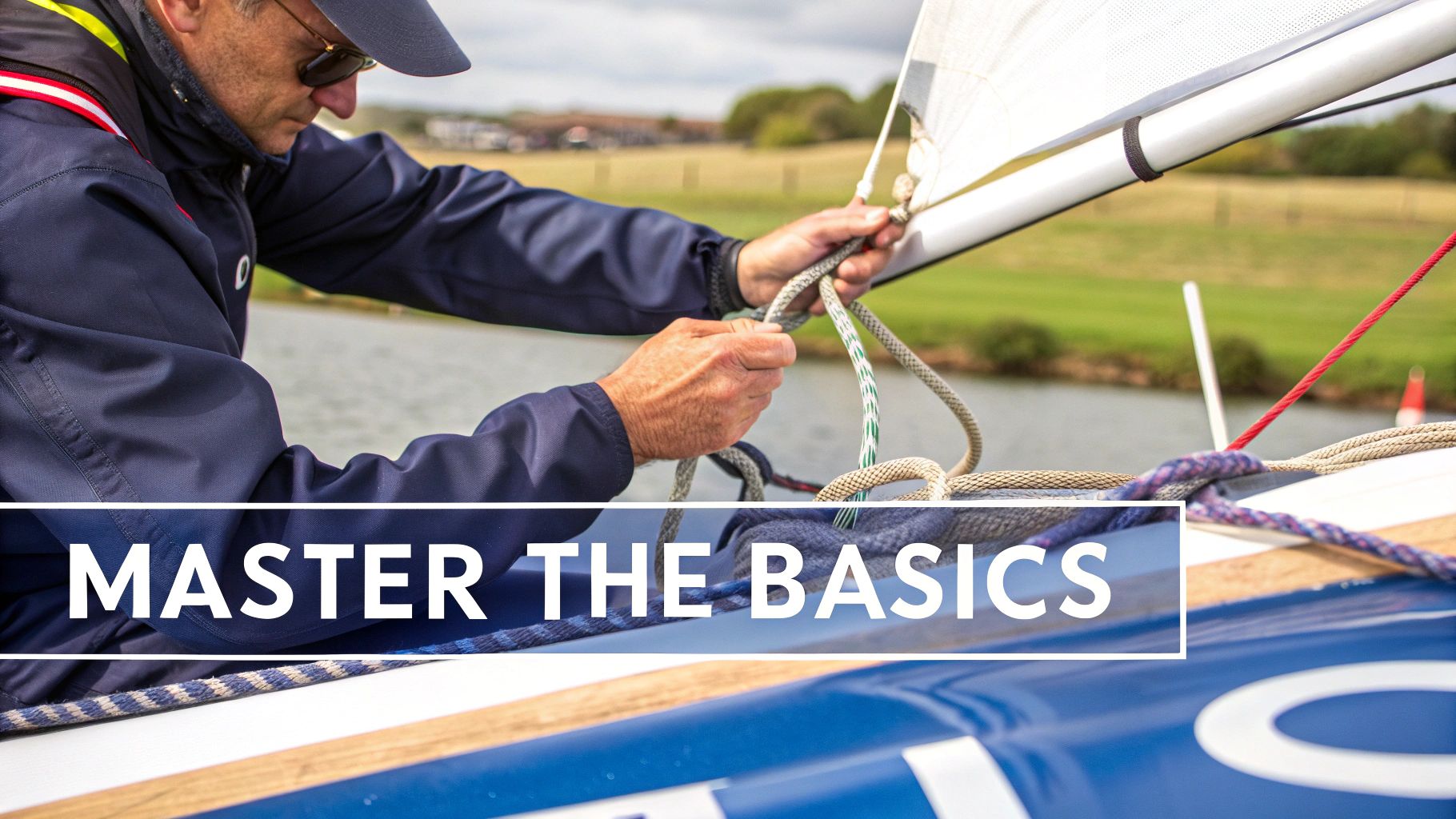
The first skill you will learn is rigging – getting the boat ready. This involves attaching the sails and ropes to the mast and hull. Your instructor will walk you through a simple process, explaining what each rope does and how it helps you control the boat.
Understanding the Wind and Your Sails
Sailing is all about working with the wind. The most crucial concept to grasp is the points of sail, which are the different directions you can travel relative to the wind. You cannot sail directly into the wind, but you can travel at many other angles to it.
Understanding these angles is the secret to steering your boat where you want it to go. Your RYA instructor will guide you through the main ones:
- Close-hauled: Sailing as close to the wind’s direction as you can.
- Reaching: Sailing across the wind. This is often the fastest point of sail.
- Running: Sailing with the wind directly behind you.
You will also learn how to trim your sails. Trimming is simply pulling the ropes to adjust the sails, making sure they catch the wind perfectly for your direction.
Turning and Changing Direction
Once you can sail in a straight line, the next step is learning to turn. There are two main manoeuvres for changing direction, and you will practise them until they feel like second nature.
These turns, known as tacking and gybing, are the fundamental building blocks of navigation. Executing them smoothly is what separates a novice from a confident sailor.
The first and most common turn is tacking. This involves turning the bow (the front of the boat) through the wind. It is a safe, controlled manoeuvre used to zigzag towards a destination upwind.
The second is gybing, which is when you turn the stern (the back of the boat) through the wind. This needs more care, as the boom—the pole at the bottom of the mainsail—can swing across the boat with force. Your instructor will show you how to manage this safely.
On our RYA courses, we break every element down into simple, practical steps, making sure you build competence and confidence every time you are on the water.
Safety First: What to Wear and Know
Feeling safe on the water is key to building confidence. The most important rule in sailing is to respect the environment, which starts with having the right kit and knowledge. Our RYA courses are built around a culture of safety, ensuring you feel secure from the start.
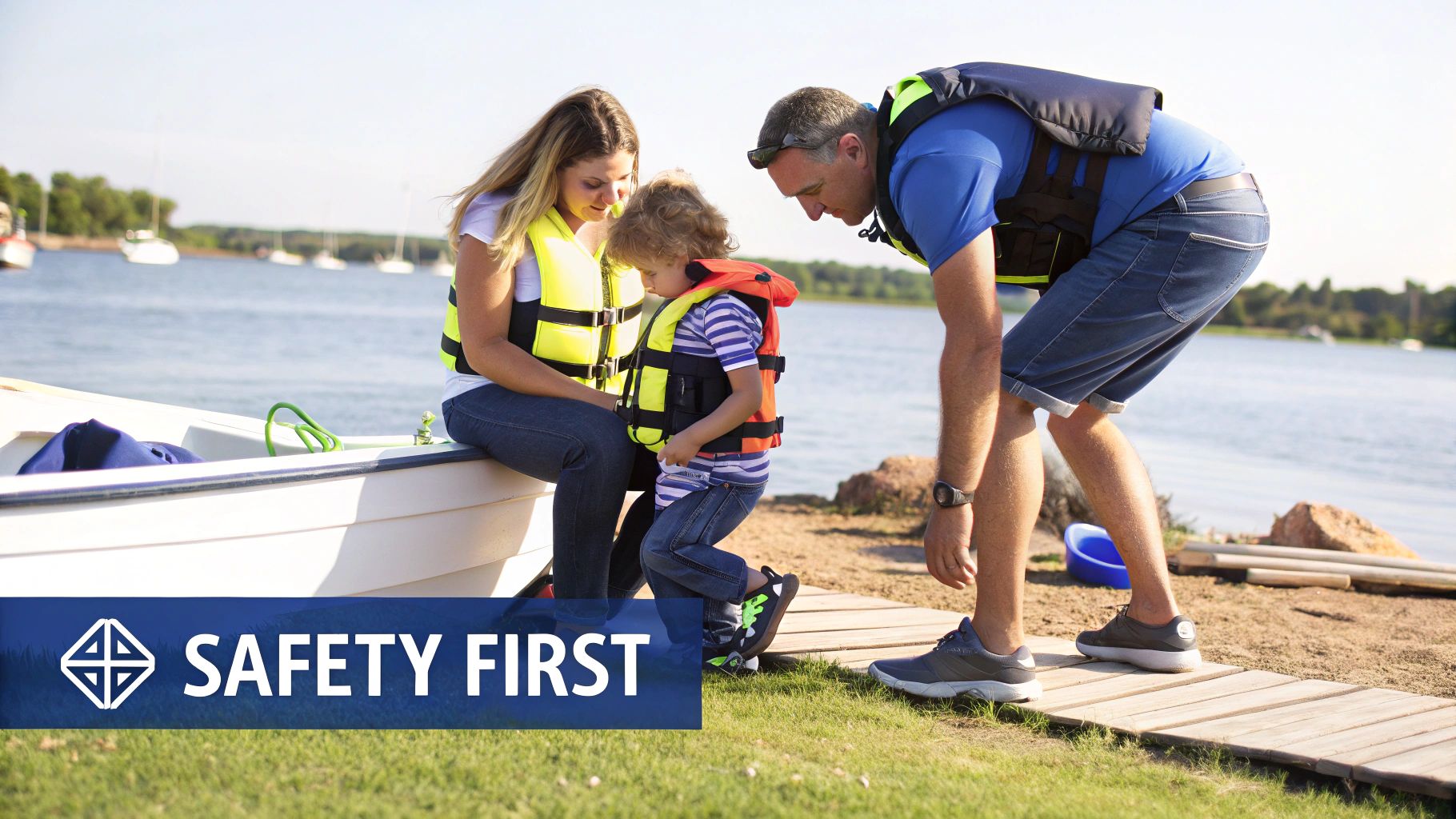
We provide the most critical piece of safety equipment: a properly fitted buoyancy aid. It is mandatory for everyone on the water at Farmoor Reservoir. Wearing one gives you the freedom to push your limits, knowing you will stay afloat if you fall in.
What to Wear for a Day on the Water
Dressing correctly makes a huge difference to your comfort and safety. The key is to layer up and choose materials that perform well when wet.
- Footwear: Old trainers or wetsuit boots are perfect. You need something with a good grip that covers your toes and that you do not mind getting soaked. Avoid flip-flops or wellies.
- Clothing: Light layers are best. Avoid cotton and jeans, as they get cold and heavy when wet. Synthetic sportswear is ideal. We have wetsuits available to hire if you do not have your own.
- Outer Layer: A waterproof and windproof jacket is a must, even on a sunny day. The wind across the reservoir can make it feel much cooler than it is on land.
Essential Safety Drills You Will Learn
A core part of your RYA training is practising safety procedures. One of the first and most important skills you will master is the capsize recovery drill.
Knowing how to confidently right a capsized boat is a massive confidence booster. We teach this in a controlled way, so it becomes just another skill rather than something to fear.
You will also learn how to get help, understand basic right-of-way rules, and check weather forecasts. Farmoor Reservoir provides a safe, enclosed environment where instructors and safety boats are always nearby. The appeal of boating is huge, with the National Water Safety Forum reporting strong participation figures, highlighting the importance of safe, structured training for all ages.
For those wanting to deepen their safety knowledge, we also offer our dedicated RYA First Aid course, which provides invaluable skills for any situation. We also run the ‘Safe and Fun’ course to build a strong safety culture.
Where Your Sailing Journey Takes You Next
Finishing your first RYA course is a huge achievement, but it is just the start of the adventure. Once you have the basics, a world of new challenges opens up. Learning to sail is the beginning of a lifelong journey on the water.
Your next steps are about building on that solid foundation. Whether you want to push your skills, try a different type of boat, or learn to teach others, there is a clear and exciting path waiting for you at Oxford Sail Training Trust.
Deepening Your Sailing Skills
With an RYA Level 2 or Youth Stage 3 certificate, you are ready to explore more advanced modules. These courses sharpen your technique and show you what a sailing dinghy is truly capable of.
- Performance Sailing: If you have a need for speed, this is the course for you. You will learn how to get every last knot of speed out of your boat using advanced sail trim and race-winning techniques.
- Seamanship Skills: This module builds your confidence to handle a wider range of conditions. You will learn how to deal with challenges like sailing without a rudder or recovering a person overboard.
- Start Racing: For anyone with a competitive streak, our introduction to racing is the perfect next step. We cover starting procedures, basic rules, and tactics to get you ready for club racing.
Exploring Other Watersports
Your RYA sailing qualification is a brilliant springboard into other thrilling watersports. The core skills you have learned—like understanding the wind and water—are directly transferable to other disciplines we offer.
Expanding into different watersports doesn’t just add variety; it deepens your whole understanding of wind and water. Every new craft you master gives you a fresh perspective that will improve your dinghy sailing.
Here are some popular pathways our sailors take:
- Advanced Catamaran Sailing: If you want to experience high-speed sailing, our catamaran courses are a must. These twin-hulled boats are incredibly fast, stable, and a thrill to sail.
- Introduction to Windsurfing: Fancy trying something more dynamic? Windsurfing combines elements of sailing and surfing, and your existing knowledge will give you a massive head start.
Becoming a Sailing Instructor
For many, the ultimate goal is to share their love of sailing with others. We provide a complete pathway to help you become a qualified RYA Dinghy Instructor. It is an incredibly rewarding journey that builds leadership and coaching skills.
It often starts with our Young Leaders Programme, designed for young sailors who want to get involved with helping out. From there, you can progress through the instructor training scheme, gaining the qualifications needed to teach the next generation of sailors.
Your Sailing Questions Answered
Starting a new adventure like sailing always brings up a few questions. To help you feel prepared, we have put together answers to the queries we hear most often at Farmoor Reservoir.
How long does it take to learn to sail?
You can learn the basics and be sailing under supervision after a two-day course, like our RYA Level 1 or the Youth Stage 1 & 2. Most people find that completing RYA Level 2 or Youth Stage 3 gives them the skill and confidence to sail independently in light to moderate winds. It is a journey, not a race, and our courses help you progress when you are ready.
Do I need to be fit to sail?
Not at all. Sailing is a great activity for all fitness levels. While some agility helps for moving around the boat, you do not need to be an athlete. Our instructors will show you smart techniques to manage the boat using balance and knowledge rather than pure strength. We are also proud to offer inclusive Sailability sessions, making the sport accessible to everyone.
What kit do I need to buy?
You do not need to buy anything for your first course. When you book with Oxford Sail Training Trust, we provide all the essential gear you need. This includes the boat, a correctly fitted buoyancy aid, and a helmet. All you need to bring are comfortable clothes you do not mind getting wet, a pair of old trainers or wetsuit boots, and a waterproof jacket.
Your only job is to focus on learning and having a great time, not worrying about expensive equipment. We have got all that covered so you can enjoy yourself from day one.
What happens if the weather is bad?
Your safety is our top priority. Our instructors constantly monitor the weather at Farmoor Reservoir. If conditions are not suitable for sailing, we use the time for essential land-based learning, like practising manoeuvres on our simulators or learning knots. If a session must be cancelled for safety reasons, we will work with you to reschedule it for a better day.
Ready to start your own adventure on the water? Oxford Sail Training Trust offers a full range of RYA courses for all ages and abilities. Book your course today and discover a passion that could last a lifetime.