
An RYA First Aid course is the essential, one-day qualification designed for anyone who spends time on the water. It teaches you how to handle medical emergencies in a marine environment, focusing on realistic scenarios like hypothermia, drowning, and managing injuries in confined spaces. This makes it a crucial certificate for all boaters, from casual sailors to professional skippers.
Why is an RYA First Aid Course Essential?
When you are out on the water, medical help is not just a phone call away. The RYA First Aid course gives you the specific skills needed to handle the unique challenges of a marine environment, from the risk of cold water shock to managing an injury on an unstable boat. Unlike a generic first aid course, this training is purpose-built for sailors, powerboaters, and watersports enthusiasts. It moves beyond the basics to address the tough realities of boating, teaching you how to respond effectively when assistance is delayed. This gives you the confidence and peace of mind needed for family outings, competitive races, and professional work alike.
Who Needs It and What You Will Learn
The RYA First Aid course is intensely practical and relevant, ensuring everyone leaves with the ability to act decisively in an emergency. It is a mandatory prerequisite for all RYA instructors and for anyone seeking a commercial endorsement on their qualifications. Here is a quick look at who this course is for and the vital skills you will learn.
RYA First Aid At a Glance
The course is essential for a wide range of people on the water. This table breaks down who benefits most and why.
| Who Needs This Course? | Why Is It Essential? | Key Skills You Will Learn |
|---|---|---|
| Professional Skippers & Instructors | It is a mandatory requirement for RYA commercial endorsements and all instructor qualifications. | Advanced resuscitation techniques, requesting medical assistance via VHF, and casualty management. |
| Racing & Offshore Sailors | It ensures compliance with World Sailing’s Offshore Special Regulations for competitive events. | Treating hypothermia, managing severe bleeding, and stabilising fractures in challenging conditions. |
| Recreational Boaters & Families | It provides the critical skills needed to handle common injuries and emergencies far from shore. | Responding to drowning incidents, dealing with seasickness, and performing CPR on a boat. |
| Young Sailors & Aspiring Leaders | It builds foundational safety knowledge and confidence for a lifetime of watersports enjoyment. | Basic life support, treating minor wounds, and understanding the importance of the recovery position. |
Ultimately, having this knowledge makes everyone on board safer and more prepared for the unexpected.
Bridging the Safety Gap on the Water
Imagine setting sail on the tranquil waters of Farmoor Reservoir with Oxford Sail Training Trust, where safety is paramount for every dinghy sail or windsurfing session. Even in controlled environments, being prepared is key. A study on amateur yacht crews in UK waters revealed a striking statistic: 42% of boats had crew members with either no first aid training at all, or only one day of training in the previous five years.
This highlights a significant gap in preparedness among recreational boaters. It also underscores why RYA First Aid courses are so important, especially as they are mandatory for professional skippers operating craft less than 60 miles from a safe haven.
The ability to provide immediate and appropriate first aid at sea can be the difference between a minor incident and a serious medical emergency. This course is about empowerment, giving you the skills to protect your crew and yourself.
Beyond this specific training, enrolling in a general essential boating safety course can further enhance your overall preparedness and confidence on the water. At the end of the day, this training is not just about ticking a box; it is about fostering a culture of safety and responsibility every time you leave the shore.
What You Will Actually Learn on the Course
The RYA First Aid course is a practical, one-day programme designed around the real emergencies you could face on the water, where professional help might be minutes, or even hours, away. Forget dry theory; this course gets you straight into hands-on scenarios. You’ll be on your knees practising CPR, applying bandages, and figuring out how to handle a casualty in the tight, often unstable space of a boat’s cabin.
This flow chart shows the simple but vital journey from being a regular boater to becoming a certified first aider, ready for anything.
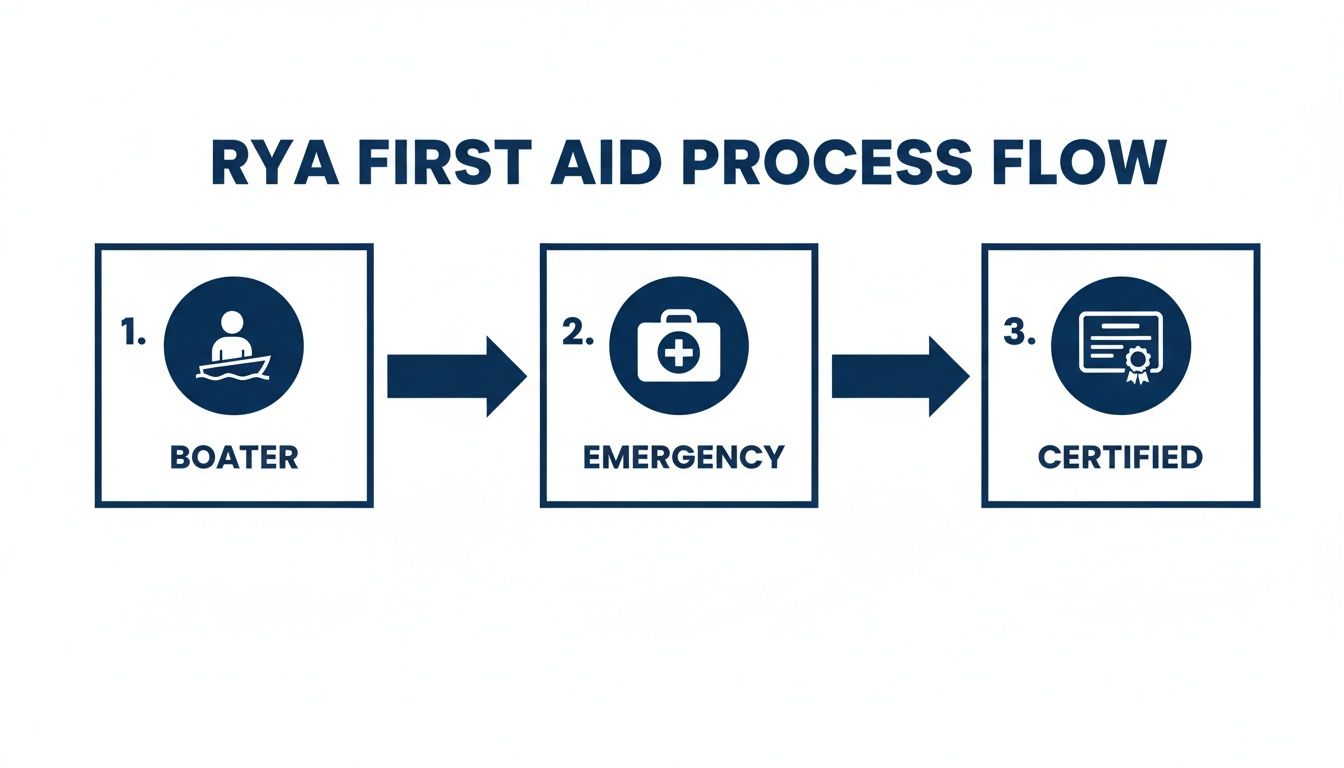
It shows how being prepared means equipping yourself with the skills to handle an emergency, which leads directly to a valuable certification.
Responding to Cold Water Emergencies
A key difference from land-based courses is understanding how seriously cold water affects the human body. This is a primary focus of the RYA course. You will learn to spot and treat the stages of hypothermia, which can set in frighteningly quickly, even in UK waters. More importantly, you will master the specific CPR protocols for drowning casualties. These are different from standard CPR, focusing on initial rescue breaths to tackle the lack of oxygen, which is the main cause of cardiac arrest in drowning incidents.
What you do in the first few minutes after pulling someone from the water can literally make the difference between life and death. This course gives you the precise, marine-specific knowledge to make those minutes count.
Managing Common Onboard Injuries
Boats are full of hazards, from swinging booms and powerful winches to slippery decks. This course prepares you for the exact types of injuries that happen in this unique environment. You will get hands-on with managing severe bleeding, learning how to apply direct pressure and when a tourniquet is needed. You will also practise how to safely stabilise someone with a suspected fracture or spinal injury—a task made much harder in the confined space of a boat cabin.
The course covers a huge range of incidents, so you’re ready for more than just the most extreme scenarios. You will also learn to handle:
- Minor Wounds: Properly cleaning and dressing cuts and grazes to prevent infection at sea.
- Burns: Treating burns from galley stoves or hot engines.
- Head Injuries: Recognising the signs of concussion and knowing how to monitor a casualty.
This practical approach ensures you do not just know what to do, but you have actually done it in a controlled, supportive environment. These skills are also a key part of our wider watersports first aid training, which perfectly complements the RYA syllabus.
Vital Communication and Casualty Care
First aid at sea is not just about patching someone up; it is about managing the situation and getting the right help. A big part of the course is dedicated to communication and aftercare. You will learn the correct procedure for using a VHF radio to make a distress call. This includes knowing the crucial difference between a Pan-Pan (for an urgent situation that is not immediately life-threatening) and a Mayday (for grave and imminent danger). Our instructors will walk you through relaying clear, concise information to the Coastguard to request medical advice or a rescue.
On top of that, the course hammers home the importance of casualty care. This includes:
- Placing a casualty in the recovery position to protect their airway.
- Learning how to improvise with the limited equipment you have on board.
- Treating for shock, a life-threatening condition that often accompanies serious injuries.
By the end of the day, you will walk away with a set of practical, repeatable skills that give you the confidence to be a truly useful skipper or crew member in a medical emergency.
Who Needs This RYA First Aid Qualification?
The RYA First Aid course is beneficial for anyone who sets foot on a boat. Emergencies do not check for qualifications before they happen, and having the skills to act decisively is a cornerstone of responsible boating. From families enjoying a day out on Farmoor Reservoir to competitive offshore racers, this course is designed to build confidence and competence. It provides the specific, marine-focused knowledge that a generic workplace first aid course simply cannot offer.
Professional Skippers and RYA Instructors
For anyone working in the marine industry, the RYA First Aid certificate is non-negotiable. It is a mandatory prerequisite for all RYA instructor qualifications, from Dinghy Instructors right through to Yachtmaster Instructors. It is also a core component for getting a commercial endorsement. If you plan to use your RYA qualification to earn a living—whether as a charter skipper or a powerboat driver—you must hold this first aid certificate.
Racing Sailors
Competitive sailing, especially offshore, comes with its own set of rules and risks. World Sailing’s Offshore Special Regulations (OSR) require a certain percentage of the crew on board for specific race categories to hold a valid first aid certificate. In the UK, the RYA First Aid course is the recognised standard for meeting this requirement.
In a racing environment, where every second counts and you might be far from assistance, having trained crew members who can manage injuries effectively is not just about compliance—it is about crew safety and performance.
Recreational Boaters and Families
This is perhaps the largest and most important group of all. For recreational sailors, powerboaters, and families, the RYA First Aid course offers invaluable peace of mind. Knowing you have the skills to handle a sudden illness or injury transforms your confidence. Think about common mishaps: a child gets a burn from the galley stove, a crewmate suffers a head knock from the boom, or someone takes an unexpected dip in the cool waters of the reservoir. This course gives you a clear, practical plan for these exact situations, all tailored for a boating environment. Many boaters find that a powerboat handling course, like our RYA Powerboat Level 2, combined with first aid training, creates a solid foundation for safe boating.
Young Sailors and Aspiring Leaders
At Oxford Sail Training Trust, we are passionate about developing the next generation of confident, capable sailors. For the young people in our youth programmes or those aspiring to join our Young Leaders Programme, the RYA First Aid course is a brilliant skill to learn early on. It teaches responsibility, builds self-belief, and equips them with life skills that are just as valuable off the water. It is a fantastic first step for any young sailor thinking about a future in instructing or simply wanting to be a more reliable member of any crew.
The UK’s boating community is built on a foundation of safety, particularly on inland waters like Farmoor. The RYA First Aid course is a cornerstone of this, fulfilling legal requirements under the Health and Safety (First Aid) Regulations 1981. A study focusing on UK vessels found that 28% of amateur yacht crews reported having inadequate first aid equipment, often linking this shortage to a lack of formal training. To understand more about these requirements, you can read the full details of the study on boating safety.
How the Course Works: Format and Certification
The RYA First Aid course is a practical and straightforward one-day programme designed to build real confidence through doing, not just listening. It fits neatly into a single day, usually running for about 8 hours. Every minute is focused on practical skills. You will be on the floor practising CPR, figuring out how to apply a tourniquet, and learning how to move someone safely in a tight space.
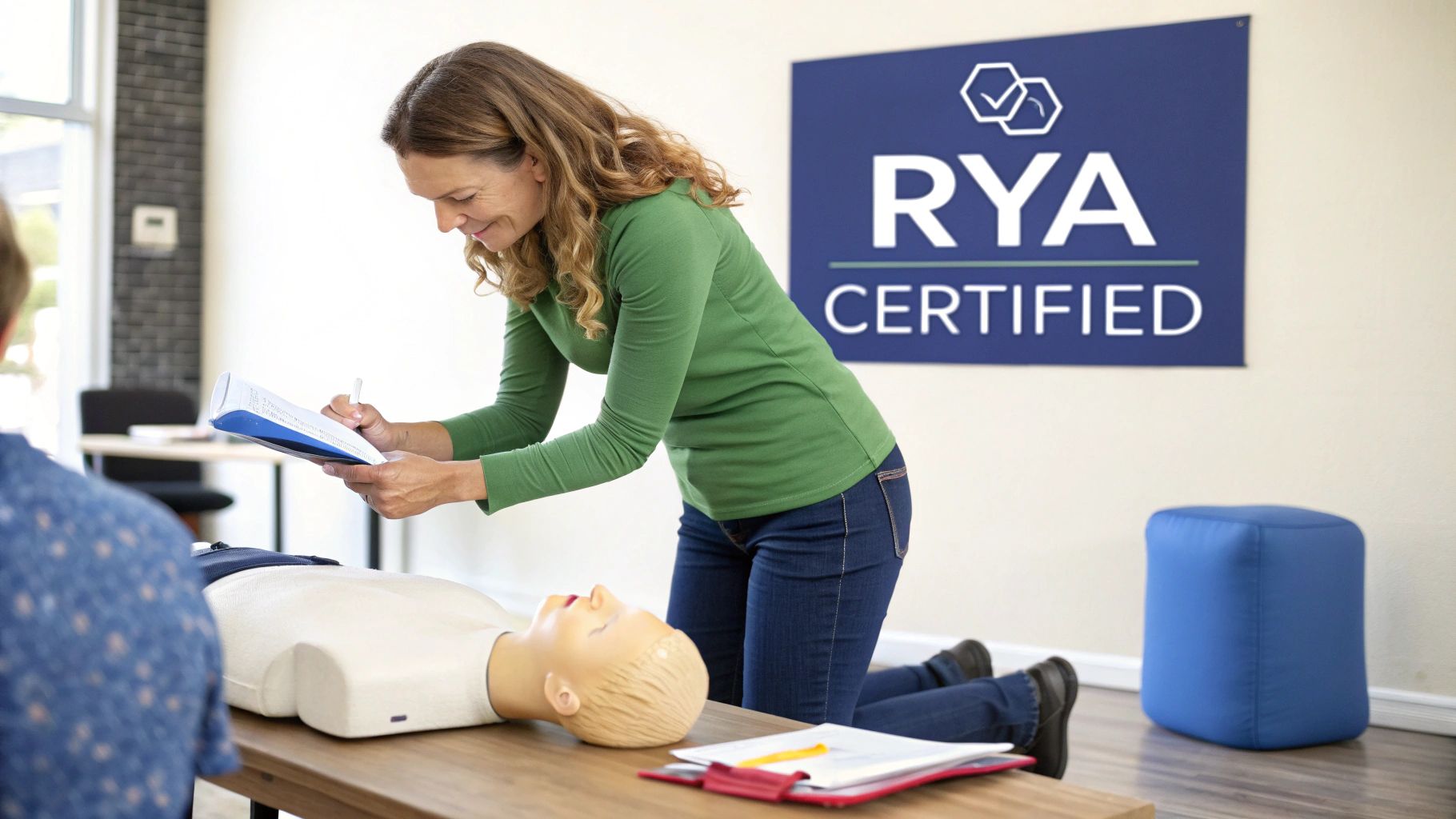
This hands-on approach is vital. When an emergency happens for real, you will not have time to dig out a textbook. Your body needs to know what to do instinctively, which only comes from physically practising the techniques.
How You Are Assessed
The assessment is supportive and stress-free. There is no big final exam or intimidating practical test. Instead, your instructor uses a method of continuous informal assessment. This means they observe you throughout the day as you take part in the different scenarios. They are looking to see that you can perform the essential skills competently and with confidence.
Some of the key skills your instructor will be looking for include:
- Performing CPR on a training manikin, including the specific techniques for drowning casualties.
- Placing a casualty into the safe and stable recovery position.
- Managing severe bleeding using direct pressure and applying dressings correctly.
- Responding to scenarios like choking, hypothermia, or shock.
The environment is designed to encourage questions and help you build your skills in a relaxed setting.
Your RYA First Aid Certificate
Once you have successfully completed the day, you will be awarded the RYA First Aid certificate. This is a well-respected qualification, recognised by maritime authorities and sailing clubs all over the world. The certificate is valid for three years. That three-year renewal cycle is incredibly important. First aid is a “perishable skill”—if you do not use it, you start to forget it. Best practices also get updated, so renewing your certificate ensures your knowledge stays sharp.
Renewing your certificate is not just about ticking a box; it is a commitment to safety. It refreshes your skills, updates you on the latest techniques, and keeps your confidence high.
As Oxford Sail Training Trust delivers RYA-recognised training, this course is a vital qualifier needed across over 2,400 global centres. It is particularly critical for anyone on the UK’s busy waterways. It is a mandatory requirement for skippers of small commercial vessels, equipping them with essential skills for handling everything from an unconscious casualty to severe bleeding. You can discover more insights about RYA training standards to see why it carries so much weight. The official RYA First Aid handbook is included in your course fee, which is perfect for stashing on board as a handy reference.
How RYA First Aid Differs From Workplace Courses
A common question is, “I already have a first aid at work certificate, do I really need another one?” The answer is yes. While any first aid training is better than none, a standard workplace course is built for a completely different world. RYA First Aid courses are specifically designed for the unique challenges you face on the water, where professional help is often a long way off.
Environment and Context
The biggest difference is the environment. A workplace first aid course assumes you are in a dry, stable building where an ambulance is only a few minutes away. On a boat, you are the first responder, and you could be the only help available for hours. The RYA course is built around this reality. It focuses on prolonged casualty care in a damp, confined, and constantly moving space.
Marine-Specific Scenarios
The RYA course tackles situations specific to boating and watersports. A generic course will teach you how to handle a fall from a ladder, but it will not prepare you for recovering someone from the water and treating them for severe hypothermia. While both courses cover CPR, the RYA syllabus includes the critical protocols for drowning victims, which are different from a typical cardiac arrest on land. You will learn how to deal with injuries caused by boating equipment and how to keep a casualty stable in a cramped, rocking cabin.
The RYA First Aid course does not just teach you first aid; it teaches you first aid at sea. This distinction is absolutely crucial.
A Direct Comparison
This table highlights the specialised, practical focus you get with the RYA First Aid course.
RYA First Aid vs Standard Workplace First Aid
| Scenario | Standard First Aid at Work | RYA First Aid Course |
|---|---|---|
| Unconscious Casualty | Focuses on the recovery position on a stable, flat floor. | Teaches how to adapt the recovery position for a confined, unstable space and manage an airway with potential water inhalation. |
| Severe Bleeding | Covers direct pressure and wound dressing, assuming clean, dry conditions. | Includes managing severe bleeding from marine-specific injuries (e.g., propellers, winches) and how to improvise with limited supplies. |
| Cardiac Arrest | Teaches standard CPR protocols for an adult on a hard surface. | Covers specific CPR protocols for drowning casualties (emphasis on rescue breaths) and how to perform chest compressions on a soft bunk or moving deck. |
| Hypothermia | Brief mention of keeping a casualty warm after exposure to cold. | In-depth training on recognising and treating the stages of hypothermia and cold water shock after immersion. |
| Getting Help | Instructs you to call 999 for an ambulance. | Teaches the correct VHF radio procedures for issuing a Pan-Pan or Mayday call to the Coastguard for medical advice or evacuation. |
This clear focus on the marine environment is precisely why a generic first aid certificate just does not cut it.
Booking Your RYA First Aid Course in Oxford
Joining us at Oxford Sail Training Trust on Farmoor Reservoir is the most direct way to get your RYA First Aid qualification. Our modern training facilities and supportive, hands-on environment are the perfect setting for practical learning. Our team of experienced, friendly instructors will guide you through every scenario, building the muscle memory you need to act decisively in an emergency.
How To Secure Your Place
Booking your spot is simple. A smooth process is key, and understanding the principles behind efficient online registration for events helps ensure everything runs without a hitch.
Here is how to join one of our upcoming courses:
- Visit Our Booking Page: Head straight to our website to see all available course dates.
- Choose a Date That Works: Pick the session that fits best with your schedule.
- Complete Your Booking: Follow the straightforward on-screen instructions to confirm your place and pay.
Once you are booked in, you will get a confirmation email with all the details you need for the day.
What You Need To Know For The Day
We provide the most important materials, including your own copy of the official RYA First Aid handbook. All you need to bring is comfortable clothing you can move around in, a notebook and pen if you like to take notes, and your enthusiasm to learn. You can find out more about what to bring by checking our booking terms and conditions.
Common Questions About RYA First Aid
It is normal to have a few questions before you commit. To help, we have put together answers to the most common queries we hear at Oxford Sail Training Trust.
Is This Course Suitable for Complete Beginners?
Absolutely. The RYA First Aid course is built for everyone, whether you have previous first aid experience or none at all. There are no entry requirements, and our instructors are brilliant at guiding total novices through every skill. The day is focused on building practical confidence in a supportive atmosphere.
How Is the Course Assessed?
There are no formal written exams or high-pressure tests. The assessment is continuous and informal. Your instructor will observe you as you take part in practical scenarios, making sure you can confidently perform key skills like CPR, deal with bleeding, and roll a casualty into the recovery position.
The assessment is not about passing or failing. It is about making sure you walk away with the practical skills and confidence to help during a real marine emergency.
How Long Is the RYA First Aid Certificate Valid For?
Your RYA First Aid certificate is valid for three years from the day it is issued. It is important to keep your certificate in date to ensure your knowledge is fresh and your skills are sharp.
What Happens If I Need to Renew My Certificate?
Renewing is simple: you just need to attend another one-day RYA First Aid course before your current certificate expires. The RYA requires everyone to complete the full day for revalidation to ensure you are brought up to speed with any changes in procedure and get a proper hands-on refresh of all essential skills.
Do I Need to Bring Anything Special to the Course?
We provide almost everything, including the official RYA First Aid handbook. All you need to bring is:
- Comfortable Clothing: Wear something that is easy to move in.
- A Notebook and Pen: Optional, but handy if you like to take notes.
- A bit of enthusiasm! Come ready to learn and get stuck into the hands-on scenarios.
Why Is This Course Better Than a Standard Workplace Qualification?
The RYA course is specifically designed for the situations you will face on the water. It covers critical topics you will not find in a typical workplace course, such as:
- Dealing with a casualty who has drowned.
- Treating hypothermia and cold water shock.
- How to call for medical help using a VHF radio.
- Managing injuries in a tight, unstable space like a cockpit or cabin.
This specialised focus makes it the most relevant qualification for anyone who spends time afloat.
Ready to gain these vital skills and become a more confident boater? At Oxford Sail Training Trust, our experienced instructors are ready to guide you through this essential course in a supportive and practical way.
