

The best way to learn to sail is to take a structured course at a recognised training centre. This approach is not just about being safe. It’s about building strong skills with expert guidance, giving you the confidence to enjoy your time on the water from day one.
Your Journey to Sailing Starts Here
Deciding to learn to sail is the first step on an amazing new adventure. It might seem a bit daunting at first, but the right setting makes all the difference. At Oxford Sail Training Trust, we offer a clear, supportive path on the safe, enclosed waters of Farmoor Reservoir. It’s an ideal place for beginners to find their sea legs without the challenge of tides or coastal traffic.
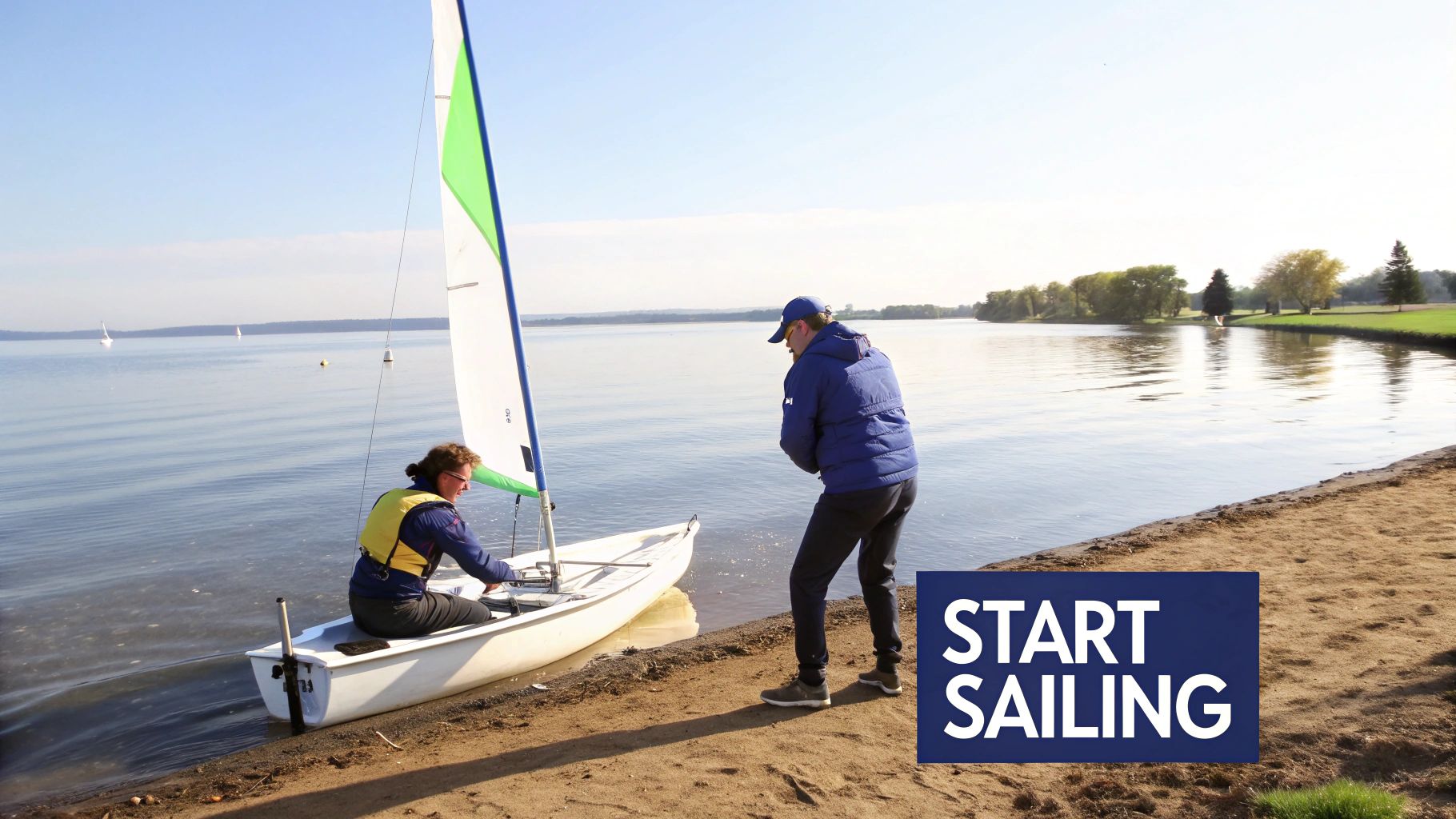
All our courses follow the Royal Yachting Association (RYA) syllabus, which is the UK’s national standard for boating. This ensures you receive high-quality, consistent training that is recognised across the country and abroad. From your very first session, you’ll be actively involved, not just sitting and listening.
The real magic of sailing is discovered through doing. It’s a hands-on skill where theory makes sense the moment you feel the wind fill the sail and the boat respond to your touch.
This practical approach is at the heart of how we teach. You’ll quickly find that sailing is an active process, where real understanding comes from direct experience. This method of experiential learning ensures skills are not just memorised but deeply felt and understood through practice on the water.
Our Courses at a Glance
To help you find the right fit, here is a quick look at the RYA courses we offer. Each one is a great starting point for your sailing journey.
| Course Name | Ideal For | Typical Duration | Key Outcome |
|---|---|---|---|
| RYA Start Sailing (Level 1) | Complete beginners (adults) | 2 days (weekend) | Basic boat handling and confidence |
| RYA Basic Skills (Level 2) | Adults who’ve completed Level 1 | 2 days (weekend) | Sailing independently in light winds |
| RYA Youth Stage 1 | Children (aged 8+) new to sailing | 2 days (weekend) or 5-day holiday course | Fundamental skills and water confidence |
| RYA Youth Stage 2 | Children who’ve completed Stage 1 | 2 days (weekend) or 5-day holiday course | Basic manoeuvres and greater control |
| Multi-Activity Weeks | Children and teens wanting variety | 5 days (holiday course) | A taste of sailing, windsurfing & paddleboarding |
| RYA First Aid | Anyone wanting essential safety skills | 1 day | Confidence to handle minor medical issues |
These courses provide a clear pathway. Our team is always here to help you figure out the best first step for you or your family.
This guide is your roadmap. We’ll walk you through choosing your first beginner course, what to expect when you arrive, the core skills you’ll build, and how you can progress.
Choosing Your First Sailing Course
The best first course for you depends on your age and what you hope to achieve. For adults new to sailing, the RYA Start Sailing (Level 1) is the perfect start. For children aged eight and over, the RYA Youth Stage 1 course is the ideal introduction.
Choosing the right course sets the tone for your entire sailing journey. Here at Oxford Sail Training Trust, we have specific entry-level courses designed to build your skills and confidence right from the start. We have distinct pathways for adults and juniors to make sure the pace and content are just right.
Let’s break down the options we offer to help you find your ideal starting point.
Your First Step as an Adult: RYA Start Sailing Level 1
For any adult who is a complete beginner, the RYA Start Sailing (Level 1) course is the perfect place to start. It’s a two-day weekend course designed to take you from knowing nothing about sailing to confidently steering a dinghy and understanding how the sails work. It’s all about practical, hands-on experience.
You won’t be stuck in a classroom memorising theory. You’ll be out on Farmoor Reservoir from day one, learning by doing. An instructor will be right there with you, talking you through every manoeuvre.
This course covers all the essentials:
- Rigging the boat: Learning how to set the sails up correctly.
- Launching and recovery: Getting the boat safely into and out of the water.
- Basic steering: Getting a feel for how the boat responds to your commands.
- Understanding wind direction: Learning how to use the wind to your advantage.
By the end of the weekend, you’ll have a solid foundation and a real sense of achievement.
Sailing Courses for Younger Sailors
Getting children out on the water young is a fantastic way to build their confidence and a love for the outdoors. Our main route for juniors is the RYA Youth Sailing Scheme, which starts with Stage 1. This is the junior version of the adult Level 1 course but tailored for children aged eight and over. The focus is on making learning feel like a game.
The key for young learners is to create a positive first experience. When children associate sailing with fun and adventure, they build a connection with the sport that can last a lifetime.
After mastering the basics in Stage 1, they can progress to Stage 2, where they start making simple sailing decisions on their own. These courses often run during the school holidays, making them a brilliant way to spend a week outside.
Fun-Focused Multi-Activity Weeks
Our Multi-Activity weeks are very popular if you’re looking for a holiday option with more variety. They’re perfect for children who want to try a bit of everything. Sailing is a big part of it, but they’ll also get to try windsurfing and paddleboarding. This approach is ideal if your child isn’t sure which watersport they’ll like best, as it gives them a taste of each one.
You can explore all our sailing courses for beginners to see the latest dates and book your spot on the water.
What to Expect On Your First Day
Your first day is designed to be fun and hands-on, not a stressful test. You will spend most of your time on the water with an experienced instructor to guide you. It’s a safe, supportive environment from the moment you arrive.
The day starts with a warm welcome. You’ll meet your instructor and the small group you’ll be learning with. You don’t need special gear; we will get you kitted out with a wetsuit and a buoyancy aid to make sure you’re warm and safe.
After that, we’ll have a relaxed chat on shore. Your instructor will give you a brief overview of the day, run through some basic safety points, and answer any questions. It’s all very low-pressure and aimed at making you feel comfortable.
Getting Hands-On from the Start
Before you can sail a boat, you need to get it ready. This is called rigging, and it’s one of the first practical skills you’ll learn. Your instructor will walk you through it, piece by piece.
You’ll learn how to attach the sails and connect the various ropes that control them. This is a brilliant way to familiarise yourself with the main parts of the boat—like the tiller for steering—before you touch the water.
You’ll also learn a couple of essential knots. These are not complicated; they are simple, practical knots that are easy to remember.
- Figure-of-Eight Knot: A basic knot used to stop a rope from pulling through a fitting.
- Round Turn and Two Half Hitches: A reliable way to tie your boat to a post or ring.
Learning these basics on land builds a solid foundation of confidence for when you get afloat.
Your First Moments On the Water
With the boat rigged, it’s time for the most exciting part: launching and sailing for the first time. We’ll help you launch your dinghy into the sheltered waters of Farmoor Reservoir. For your first outing, your instructor will be in the boat with you, offering direct guidance.
The initial focus will be on steering with the tiller and understanding the wind. The wind is your engine, and learning how to use it is the art of sailing. Your instructor will show you how to set your sail to catch it just right.
The moment you first feel the wind catch the sail and the boat starts to move silently is truly magical. It’s a feeling of freedom and connection with nature that gets people hooked on sailing for life.
You’ll start by sailing across the wind (a ‘beam reach’), which is the simplest way to sail. This lets you focus on steering and sail control. The whole experience is managed at a gentle, comfortable pace.
Safety and Support Are Always the Priority
Throughout your first day, your instructor’s main job is to ensure you feel safe and supported. The enclosed, non-tidal nature of Farmoor Reservoir provides a predictable and calm environment, perfect for learning.
Our instructors are always in radio contact with our safety boat team, who constantly patrol the reservoir. This professional oversight means help is always on hand, allowing you to relax and enjoy learning something new. The goal is to give you a positive, confidence-building experience. You’ll leave feeling excited for day two.
Building Your Skills with the RYA Pathway
Your first course is just the beginning. The Royal Yachting Association (RYA) has a clear progression that takes you from a beginner to a skilled, independent sailor. We follow this pathway at Oxford Sail Training Trust, ensuring there’s always a next step for you.
Your RYA Start Sailing (Level 1) course gives you the essential building blocks. You’ll learn fundamental skills like turning the boat through the wind (tacking) and understanding how to position your boat relative to the wind (the ‘points of sail’).
This simple infographic breaks down what to expect on your very first day.
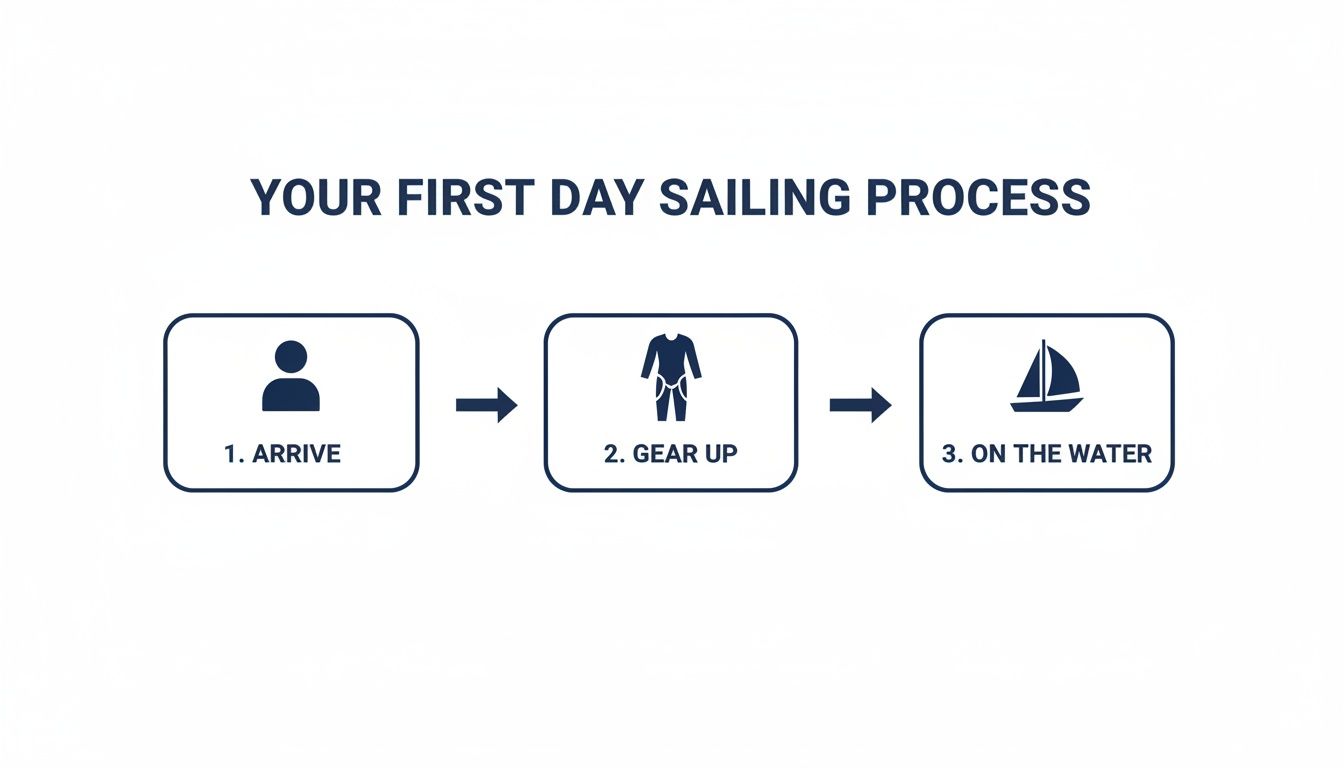
It shows how we move you smoothly from arrival to getting active on the water, making the whole experience feel structured and stress-free.
Achieving Independence with Level 2
Once you’ve completed Level 1, the next step is the RYA Basic Skills (Level 2) course. This is where you become a self-sufficient sailor. The main goal is to refine what you’ve learned so you can confidently sail a dinghy on your own in light winds.
During this two-day course, you’ll build on your existing knowledge with a focus on your own decision-making. You’ll spend more time sailing solo, without an instructor in the boat with you.
You’ll practise key manoeuvres, including:
- Rigging and launching independently.
- Improved tacking and gybing techniques.
- Recovering a person overboard safely.
- Understanding the five essentials of sailing.
By the end of this course, you’ll have a certificate that is often the minimum requirement for hiring a dinghy at sailing centres across the UK.
The Pathway for Young Sailors
The RYA Youth Sailing Scheme mirrors the adult pathway but is broken down into four stages. After completing Stages 1 and 2, which are similar to the adult Level 1, young sailors can keep progressing.
- Stage 3: Focuses on rigging, launching, and sailing a dinghy independently in any direction.
- Stage 4: Introduces sailing a double-handed boat as both helm and crew.
This staged approach ensures children learn at a comfortable pace, building confidence and skills progressively.
“The RYA pathway is designed to be a ladder. Each rung you climb gives you new skills, new confidence, and a new perspective on the water. The journey itself is just as rewarding as reaching the top.”
Advancing Your Sailing Skills
Once you have your Level 2 certificate, a world of specialised sailing opens up. These advanced modules let you explore different aspects of the sport. At Oxford Sail Training Trust, you can continue to learn to sail by progressing onto other exciting courses.
These courses include:
- Seamanship Skills: Refines your boat handling, teaching you to sail without a rudder and handle tricky situations.
- Sailing with Spinnakers: Learn how to use large, colourful downwind sails to get the best performance from your boat.
- Start Racing: Introduces you to the basics of club racing, from starting procedures to rules and tactics.
The full range of RYA sailing courses offers a continuous learning journey, allowing you to develop from a complete novice into a highly skilled sailor.
Staying Safe On The Water
Your safety is our top priority. We know that the fastest way to learn is by feeling completely secure. Our entire operation is built around robust safety measures, expert instruction, and the perfect learning environment of Farmoor Reservoir. You can relax and focus on the fun of sailing.
We operate a fleet of modern safety boats, which are always on the water during training. They are crewed by qualified instructors who are experts in sailing, rescue techniques, and first aid.
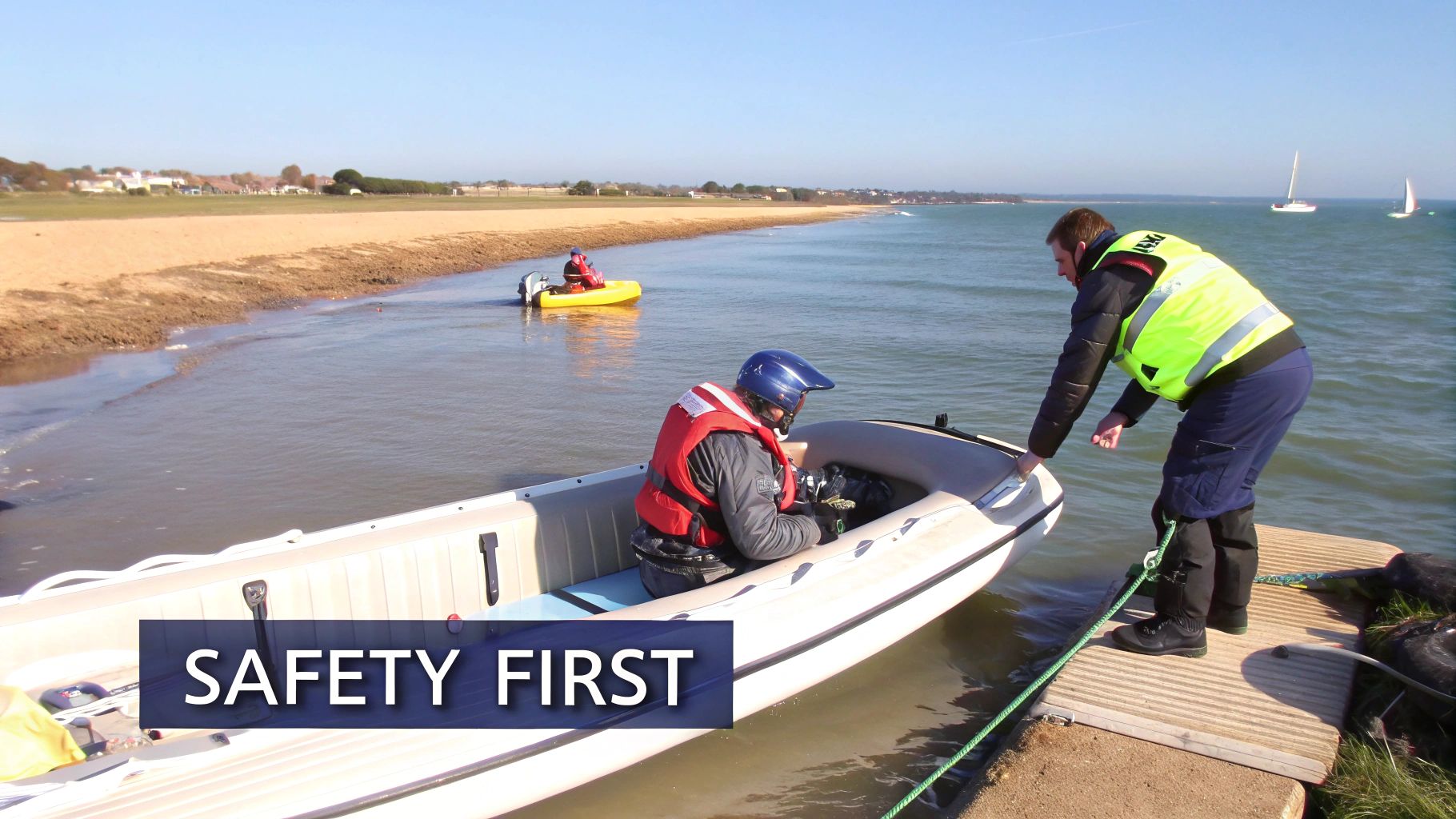
The enclosed nature of Farmoor Reservoir also provides a predictable setting, free from tricky currents and commercial traffic. This managed environment is a key reason why it’s such a fantastic place to learn to sail.
Your Essential Kit Guide
Coming prepared with the right kit will make your day more comfortable. While we provide the most important safety gear, what you wear underneath makes a big difference.
Your Sailing Kit Checklist
| Provided by OSTT | What to Bring Yourself |
|---|---|
| High-quality wetsuit | Old trainers or wetsuit boots (no open toes!) |
| RYA-approved buoyancy aid | Swimwear (to go under the wetsuit) |
| Modern, well-maintained boats | Towel and toiletries for a shower |
| All sailing-specific equipment | Sun cream, a hat, and sunglasses |
| Expert instruction and safety cover | A refillable water bottle |
We supply top-quality wetsuits and buoyancy aids. A buoyancy aid is mandatory and is designed to keep you afloat if you end up in the water. Wetsuits keep you warm by trapping a thin layer of water against your skin, which your body heats up.
Dressing For The Weather
Here’s a golden rule: avoid cotton clothing. When cotton gets wet, it loses its warmth and makes you feel cold quickly. Instead, choose synthetic, quick-drying layers if you’re wearing anything under your wetsuit on a cooler day.
Understanding and preparing for the conditions is a fundamental part of seamanship. Dressing correctly isn’t just about comfort; it’s a core safety skill.
This proactive approach to safety extends beyond just what you wear. As you progress, understanding wider boating knowledge is key, like how to prevent carbon monoxide poisoning on larger vessels.
Controlled Safety Drills
Learning how to handle unexpected situations is a core part of building real confidence. One of the most important skills we teach is the capsize recovery drill. This might sound scary, but it’s a standard, controlled exercise we practise in a safe way.
Your instructor will guide you step-by-step, showing you how to right the boat and get back in. Practising this in a calm environment means that if it ever happens for real, you’ll know what to do without panicking. It often turns out to be one of the most empowering parts of the course!
For those wanting to deepen their knowledge, we also offer our RYA First Aid course. You can learn more if you’re interested in developing these vital skills further.
https://oxfordsailtraining.org.uk/first-aid-watersports/
Your Sailing Questions, Answered
It’s normal to have a few questions before you start. We’ve put together the most common queries we hear to give you clear, honest answers so you can feel excited about getting started.
Do I Need to Be Super Fit or Able to Swim?
You do not need to be an athlete to sail a dinghy. Sailing is more about technique and balance than strength. Our courses are for everyone, regardless of fitness level.
As for swimming, being comfortable around water helps, but you don’t need to be a champion swimmer. Everyone wears a modern buoyancy aid on or near the water. These are designed to keep you floating safely if you take a dip. In fact, a controlled capsize is a standard part of learning and builds a huge amount of confidence.
How Long Does It Realistically Take to Sail on My Own?
After completing the RYA Start Sailing (Level 1) and RYA Basic Skills (Level 2) courses, you’ll have the skill to sail a dinghy on your own in light winds. This usually takes four days in total, often split over two weekends.
Think of your RYA Level 2 certificate like a driving licence. It confirms you’re safe to head out alone, but your real skill and confidence come from practice.
This is why we offer many ways to keep sailing after your courses, such as hiring a boat for an afternoon to practise. The more time you spend on the water, the more intuitive it all becomes.
Is There a ‘Right’ Age to Start Sailing?
No. People from every generation discover a love for the sport. Our RYA Youth Sailing Scheme is open to children from eight years old. Youngsters often pick up new physical skills quickly, and we design our courses to feel like an adventure.
At the same time, we teach many adults who are stepping into a boat for the first time. Your enthusiasm is far more important than your age. It’s never too late to start.
What Happens If the Weather Turns Bad?
Sailing is all about the weather. We can sail safely in a bit of rain and a range of wind strengths—a good breeze is what we need!
Your safety is always our priority. If the wind is too strong for beginners, or if there’s no wind, we won’t go afloat. In those cases, we have plenty of valuable skills to cover on shore. We can use our on-shore simulators and work on things like rigging and knot-tying. If extreme weather causes you to lose a big chunk of your on-water time, we will always do our best to reschedule that session for you.
Ready to start your own sailing adventure? At Oxford Sail Training Trust, we have the perfect beginner’s course to get you out on the water with confidence. Explore our full range of RYA-accredited courses and book your place today.

